
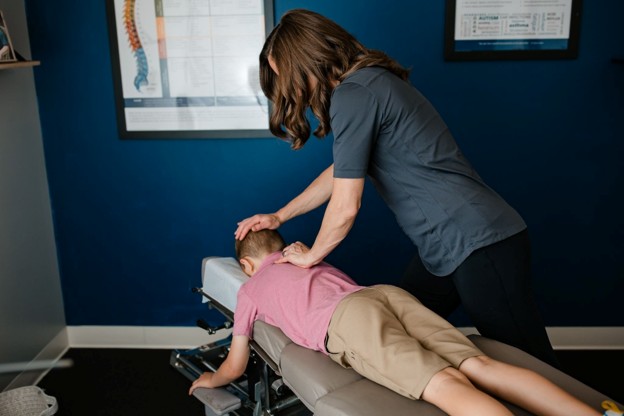
If you’re looking for a family chiropractor in St. Charles, MO, you may be surprised to learn that chiropractic care is about much more than neck pain or back pain. Your nervous system controls every function in your body, from digestion and sleep to immune function, focus, hormones, and overall health.
At Healthy Beginnings Chiropractic, we help families understand how nervous system function affects their daily lives. Whether you’re concerned about recurring illness, chronic stress, poor sleep, headaches, digestive issues, or simply want to support your family’s long-term wellness, understanding the connection between the spine and nervous system is often the first step.
Many of the symptoms families struggle with every day can be linked to a nervous system that is stuck in a constant state of stress. The good news is that when we identify those patterns and support the nervous system appropriately, the body is often able to function more effectively.
If you’ve ever wondered why one of your kids seems to catch every bug that goes around, why you can’t shake that constant fatigue no matter how much sleep you get, or why your spouse has been dealing with brain fog and digestive issues that no one seems to have answers for? Well, you’re not alone. And honestly, the answer might be simpler than you think.
At Healthy Beginnings Chiropractic in St. Charles, we talk about the nervous system every single day. Not because it’s trendy, but because it’s the literal command center of your entire body, and when it’s not working the way it should, everything else suffers.
Think of your nervous system as the master control system for every single function in your body. It regulates your immune response, your digestion, your sleep cycles, your hormones, your kids’ ability to focus in school, and your back pain too! It does all of this through a beautifully complex network, and at the center of that network is a nerve called the vagus nerve.
The vagus nerve is the longest cranial nerve in the body. It runs from your brainstem all the way down through your heart, lungs, and digestive system. It’s the key player in your body’s ability to shift between stress mode and recovery mode which is what scientists call the sympathetic and parasympathetic nervous systems.
When the vagus nerve is functioning well this is what researchers call having good “vagal tone.” This allows your body to heal, regulate, and thrive. But when vagal tone is low? Your system gets stuck in stress mode.
We live in a world that constantly pushes our nervous systems into overdrive. At Healthy Beginnings Chiropractic, we talk about this through the lens of what chiropractors call the Three T’s: Trauma, Toxins, and Thoughts.
Trauma includes physical stressors like car accidents, sports injuries, the repetitive strain of staring at a screen all day, or even the physical demands of carrying and delivering a baby. For kids, it might be a fall off the playground, and always to a degree, the process of being born (this is our first trauma).
Toxins are the chemical stressors our bodies process constantly. Such as processed foods, environmental pollutants, medications, and everyday household exposures.
Thoughts are the emotional and psychological stressors. Anxiety, chronic worry, overwhelm, and emotional trauma all register as real, physical stress in the nervous system.
When the nervous system is bombarded by all three, repeatedly, over time it gets locked into a state of sympathetic overdrive. And that’s where things start to unravel for families.
We’re not just talking about back pain. A nervous system stuck in fight-or-flight mode can show up as:
We see this in adults. We see it in teenagers. And we see it in children who are far too young to be carrying this kind of stress in their bodies.
One of the things families tell us they love about Healthy Beginnings is that we show you exactly what’s happening in your nervous system. Not just what we think based on your symptoms.
We use Insight Technology — a three-part, non-invasive neurological assessment that includes:
Surface EMG (sEMG): Measures the electrical activity in the muscles along your spine. Muscle tension patterns directly reflect how your nervous system is communicating with your body.
Thermography: Detects temperature differences along your spine, which reveal how well your autonomic nervous system is regulating blood flow and organ function. We can even perform this on infants without touching the skin, the sensors simply scan along the spine.
Heart Rate Variability (HRV): Measures the adaptability of your nervous system which tells us how well it shifts between stress and recovery. HRV is one of the most researched indicators of overall health and resilience.
Together, these three scans give us a real-time picture of where your nervous system is right now. For adults and older children, we may also use X-rays to show us the structural history of your spine and where the patterns of stress have accumulated over time. (We do not take X-rays on pregnant women or infants.)
This is what we mean when we say we meet every patient exactly where they are. We’re not guessing. We’re measuring.
Our approach at Healthy Beginnings is centered on very specific, focused chiropractic adjustments that address areas of the spine where nerve interference, what we call subluxation, is limiting your nervous system’s ability to communicate and function at full capacity.
When that interference is removed through an adjustment, your nervous system gets the signal it needs to shift out of overdrive and into healing mode. That’s not a side effect. That’s the whole point.
We work with entire families, from newborns and toddlers to parents and grandparents. And what we see, time and again, is that when the nervous system is supported, the body does what it was designed to do: heal, adapt, and thrive.
Whether you’re bringing in your four year old for recurring ear infections, your teenager who can’t focus, or yourself because you’ve been running on empty for months, we want to see what’s actually going on beneath the surface. Because understanding the root cause is the first step toward real, lasting change.
At Healthy Beginnings Chiropractic, new patient appointments include a full nervous system assessment using Insight Technology so we can get a clear picture of where you and your family are starting from, and where you’re headed.
Schedule your family’s new patient appointment here.
We are located at 2440 Executive Drive in St. Charles, MO. We’d love to meet your family.
A family chiropractor provides chiropractic care for individuals at every stage of life, including infants, children, teenagers, adults, and seniors. At Healthy Beginnings Chiropractic, our focus is on supporting nervous system function so the body can adapt, heal, and function at its best.
Chiropractic care focuses on identifying and correcting areas of spinal dysfunction that may interfere with nervous system communication. When the nervous system functions more efficiently, the body is better able to regulate sleep, digestion, stress responses, and overall wellness.
Nervous system scanning uses technology such as Surface EMG, Thermography, and Heart Rate Variability (HRV) to evaluate how the nervous system is functioning. These scans help measure stress patterns and track progress throughout care.
Vagal tone refers to how effectively the vagus nerve helps regulate your body’s stress response. Healthy vagal tone supports relaxation, digestion, immune function, emotional regulation, and overall resilience.
Pediatric chiropractic care uses gentle, age-appropriate techniques designed specifically for infants and children. Adjustments for children are very different from those used for adults and are tailored to the child’s age, size, and needs.
Families choose Healthy Beginnings Chiropractic because of our focus on nervous system health, family wellness, pediatric and prenatal expertise, and our use of Insight Technology to objectively measure nervous system function and progress.
Porges, S.W. (2011). The Polyvagal Theory: Neurophysiological Foundations of Emotions, Attachment, Communication, and Self-Regulation. W.W. Norton & Company.
Thayer, J.F. & Lane, R.D. (2009). Claude’s theory of emotion and the vagal motor neuron: A meta-analysis. Biological Psychology, 81(3), 229–240.
Seaman, D.R. (2013). The resting or recumbent posture and pain. Journal of Chiropractic Medicine, 12(4), 237–243.
McCraty, R., & Shaffer, F. (2015). Heart Rate Variability: New Perspectives on Physiological Mechanisms, Assessment of Self-regulatory Capacity, and Health Risk. Global Advances in Health and Medicine, 4(1), 46–61.
Kent, C. (1996). Models of Vertebral Subluxation: A Review. Journal of Vertebral Subluxation Research, 1(1), 11–17.